
What should I do if I can’t pay a medical bill?
Medical billing is complex. Make sure the provider accurately calculated the medical bill and that you owe it before you pay. Also check for protections under federal and state law as well as financial assistance that you may be entitled to claim.
If you can't pay a medical bill, first make sure you owe the amount charged. Review the bill for errors, check that your health insurance was applied correctly, and see whether you qualify for financial assistance or charity care. You may also have protections under federal or state law that reduce what you owe as well as provide protections from debt collection and credit reporting.
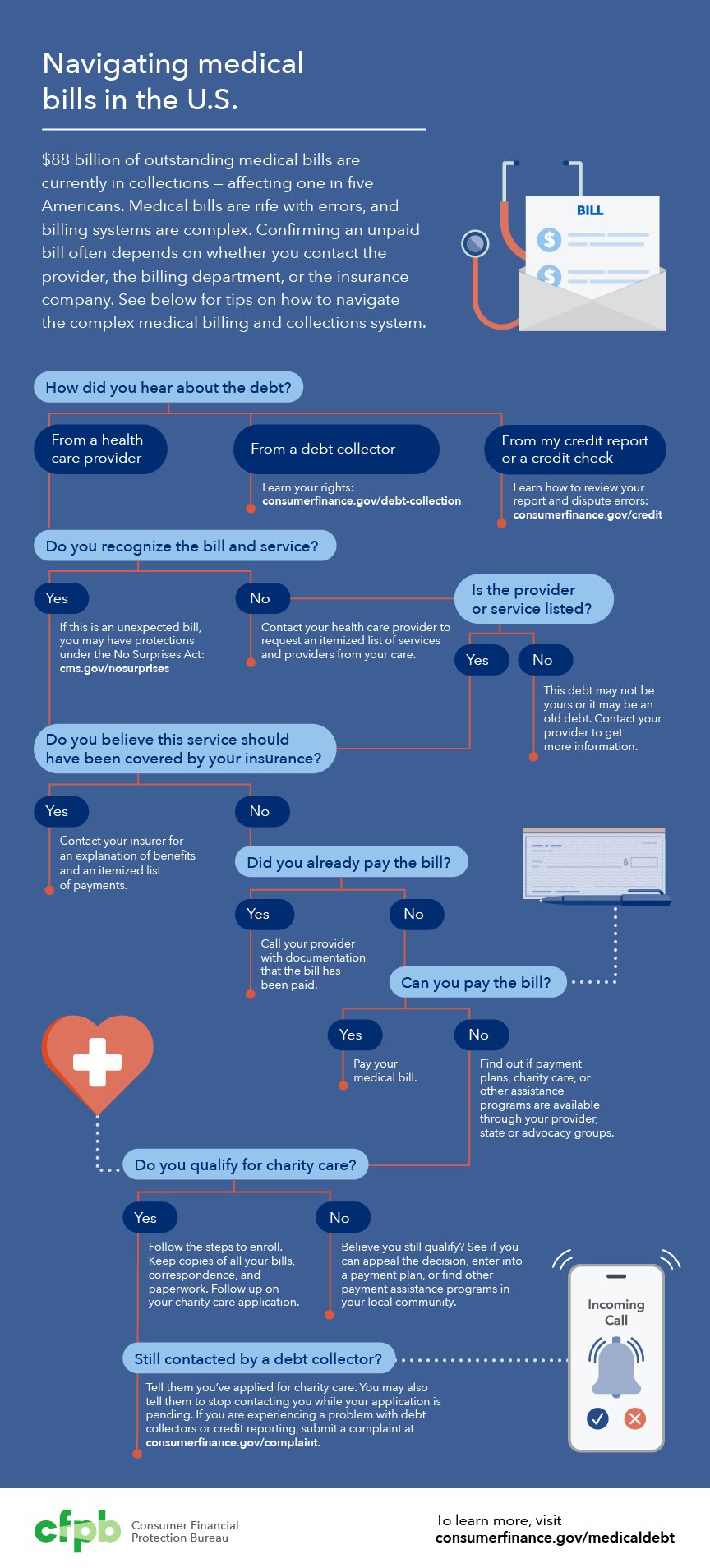
If you still owe part of the bill, ask about payment plans or other options before the debt becomes more difficult to manage. If you do nothing and don’t pay, you could be facing late fees and interest, debt collection, lawsuits, garnishments, and lower credit scores.
Do you owe the bill?
First, make sure that you owe the bill. You could have already paid it. It’s also possible that the provider or debt collector has confused you with someone else with a similar name.
Second, check the charges. If something doesn’t look right, ask for an itemized list of charges. Some questions to consider:
Look for billing errors like being charged for the same service or treatment twice. If you are unsure, talk to the accounting or billing office of your provider. Their number and contact information will be on the billing statement. You want to do this quickly so you can get any charges resolved and to avoid late fees and interest.
Third, if you disagree with the charges or want more information, you have the right to an appeal with your health insurance company
Finally, remember that you can also dispute a medical bill with a debt collector or a credit reporting company.
Is the bill a “surprise” medical bill?
Effective January 1, 2022, the No Surprises Act (NSA) protects you from “surprise billing” if you have health insurance and provides some protections from surprise medical bills if you are uninsured. If you’re insured, the law bans certain practices, like requiring you to pay out-of-network charges for emergency services. Check and see if it applies to you. This surprise billing usually occurs after you receive care at an out-of-network facility or at an out-of-network provider and your insurance does not cover the out-of-network cost. In these situations, the No Surprises Act can protect you from owing the difference between the out-of-network billed cost and the amount your health insurance paid. Some services, such as ground ambulance transportation services, are NOT protected by the No Surprises Act.
Is there financial help or “charity care” for my medical bills?
Financial assistance programs, sometimes called “charity care,” provide free or discounted health care to people who need help paying their medical bills. The Affordable Care Act (ACA) requires hospitals with 501(c)(3) nonprofit status to have programs to provide this care
Read more detailed information about financial assistance programs and charity care.
Other protections
Older adults: If you apply for and are covered by the Qualified Medicare Beneficiary (QMB) program
TIP
To make sure your provider knows you’re in the QMB Program, show both your Medicare and Medicaid or QMB card each time you get care. You can also give your provider a copy of your
Medicare Summary Notice (MSN). Your MSN will show you’re in a QMB Program and shouldn’t be billed. Log in to your MyMedicare.gov
Veterans: You may qualify for financial hardship assistance
What if I still owe the bill?
If you still owe the bill or a part of it, here are some options:
- Negotiate the bill down to an amount that you can afford
- Ask if the provider will accept an interest-free repayment plan
- Look for help paying medical bills, prescription drugs, and other expenses. Some nonprofit organizations provide financial help as well as help for drugs necessary for your medical care or even certain medical conditions.
- Be careful about using a credit card or a medical credit card to pay off the bill. There may be high interest and you may lose the ability to negotiate the debt. There may be better options like an interest-free repayment plan.
You also have protections from faulty credit reporting or if you are contacted by a debt collector.
Where can I go if I need more help?
If you are unable to resolve your billing dispute to your satisfaction, you have several options.
Consumer Assistance Programs. Many states provide help for consumers experiencing problems with their health insurance. This state map will help you find assistance
Centers for Medicare & Medicaid Services offers detailed information about your protections
State agencies such as your state attorney general
CFPB. If you have a problem with debt collection because of a surprise medical bill, or a problem with credit reporting because of surprise medical charges listed as negative items on your credit report, you can submit a complaint with the CFPB online or by calling (855) 411-CFPB (2372).
Page last modified @